
Single boiler vs heat exchanger vs dual boiler espresso machines
How the three espresso machine architectures actually differ in workflow, temperature stability, cost, and which one fits your drinks-per-day reality.
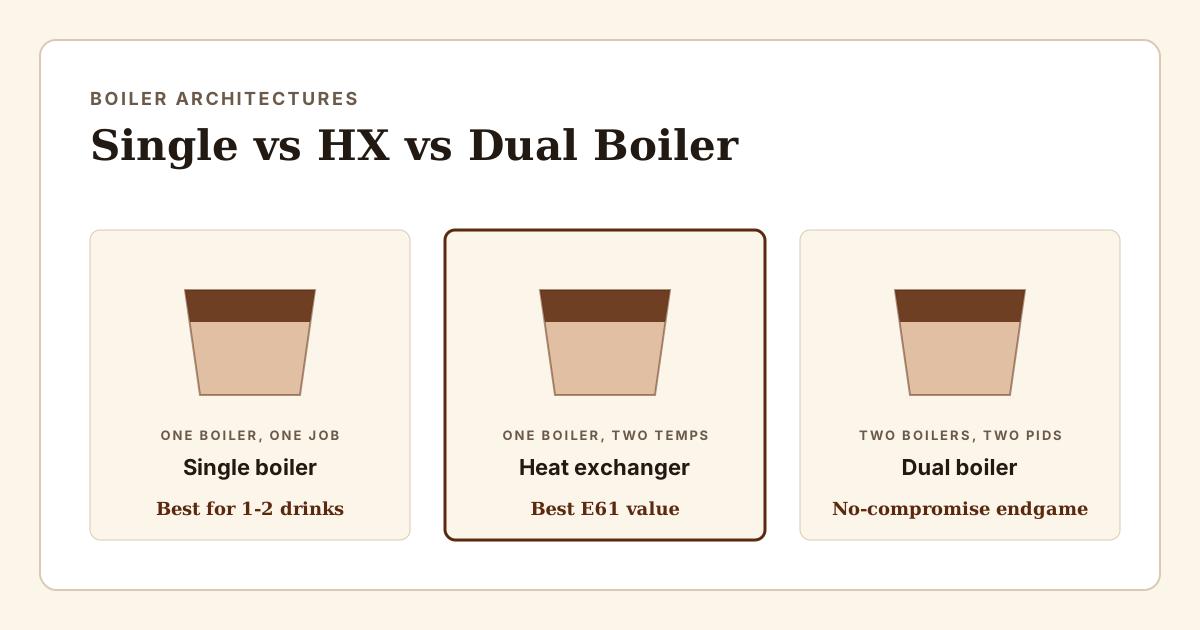
What you'll need
- An honest drinks-per-day count : One latte at 7 am is a single-boiler problem. Four back-to-back milk drinks on a Saturday is a dual-boiler problem.
- A grinder budget that's at least equal to the machine : Boiler architecture matters less than grind quality. Don't shortchange the grinder to fund a fancier boiler.
- Counter depth and outlet check : Dual boilers and E61 HX machines are 14 inches deep and 30+ lbs. Some need a dedicated 15A or 20A circuit.
- A representative single boiler : Breville Bambino Plus or Gaggia Classic Pro with PID. Sub-$700 and capable of cafe-quality shots.
- A representative heat exchanger : Rocket Appartamento or ECM Classika. E61 group, ~$1,900-$2,400, decades of service life.
- A representative dual boiler : Breville Dual Boiler at the value end, Lelit Bianca or ECM Synchronika at the enthusiast end.
TL;DR
Single boiler machines brew and steam with the same heating element, so you wait 30 to 90 seconds between shot and milk. Cheapest, smallest, plenty for one or two drinks a day. Heat exchanger (HX) machines pull water for the brew through a tube running through the steam boiler, so you can brew and steam simultaneously, but brew temperature drifts and needs a “cooling flush.” Dual boiler machines have two independent boilers with PID control on each: simultaneous brew and steam, rock-stable temperature, but more money, more counter space, more to maintain.
For most home users pulling fewer than four milk drinks at a time, a single boiler with a PID is the right answer. Heat exchangers make sense if you love Italian E61 machines and don’t mind learning the temperature dance. Dual boilers are the endgame.
This guide is about boiler architecture specifically; for the broader question of picking a first machine across price and features, see how to choose your first espresso machine.
What the three architectures actually do
The differences come down to how water gets heated for brewing versus steaming, and what that means for workflow.
Single boiler (SBDU: single boiler, dual use)
One boiler. To brew espresso, it sits at ~93°C / 200°F. To steam milk, it ramps up to ~130°C / 266°F. You hit a switch, wait for the boiler to come up, steam your milk, then either wait for it to cool back down or run a cooling flush before the next shot.
Examples: Gaggia Classic Pro, Rancilio Silvia, Breville Bambino, Lelit Anna, Profitec Go (in its base config).
The switching is the entire compromise. If you’re making one cappuccino, you brew first, flip to steam, steam, done. If you’re making two cappuccinos for two people, the second drink’s espresso is sitting on the counter going cold while you steam, or the milk is sitting and separating while you re-cool the boiler. There’s no way around it.
Modern PID-equipped single boilers (Gaggia Classic Pro with PID mod, Bambino Plus, Lelit Anna with built-in PID) have made brew temperature in this class genuinely excellent. The shot quality ceiling on a $500 PID single boiler is, to a blind taster, indistinguishable from a $2,500 dual boiler. What separates the two in daily use is the workflow, not anything you can taste in the cup.
Heat exchanger (HX)
One boiler, filled mostly with steam-temperature water (~120°C). A thin copper tube runs through the boiler. When you pull a shot, fresh water from the reservoir flows through that tube, picks up heat on the way, and arrives at the group head at roughly brew temperature.
The clever part: one boiler, two temperatures, simultaneous use. You can steam milk and pull a shot at the same time, which is the workflow win.
The catch: when the machine has been idle, water sitting in the HX tube is way hotter than 93°C. The first shot off a cold-idle HX machine will scald the coffee. So you do a cooling flush: pull a few ounces of water through the group head before the shot, until the temperature settles. Experienced HX owners read the flush by sound (the hiss-to-flow transition) or by a thermometer on the group.
Examples: Rocket Appartamento, ECM Classika, Profitec Pro 500, Quick Mill Andreja. Most “E61 group” machines under $2,500 are HX.
HX machines have a charm that’s hard to argue with. The E61 group is a beautiful piece of engineering, they hold temperature stably under load, they last decades, parts are universal. But the cooling flush is real, and it’s the thing new HX owners underestimate.
Dual boiler
Two completely separate boilers, each with its own PID. The brew boiler sits at exactly 93°C (or wherever you set it). The steam boiler sits at ~125°C. They don’t interact.
Examples: Breville Dual Boiler, Profitec Pro 300, Lelit Bianca, ECM Synchronika, La Marzocco Linea Mini, Decent DE1.
It’s the most temperature-stable design. Brew temperature is whatever you set it to, stable shot to shot, no flush, no wait. Steam is ready in parallel. You can pull a shot while frothing milk for the next drink, and the temperature on shot number five is the same as on shot number one.
Cost is the obvious trade. Sub-$1,200 dual boilers exist (Breville Dual Boiler) but most start at $1,800 and climb past $4,000. They’re also physically larger, draw more power (some need a 20A circuit), and have twice the boilers to descale.
Which one for which person
Solo drinker, one or two drinks in the morning: single boiler with PID. A Gaggia Classic Pro ($450), Bambino Plus ($500), or Lelit Anna PID ($800) makes espresso indistinguishable from machines five times the price. The wait between brew and steam is 30 to 60 seconds, which is exactly the time you need to wipe the portafilter and pour milk into the pitcher anyway. You’re not missing anything.
Couple making four drinks back to back: heat exchanger or dual boiler. Single boilers genuinely become annoying here. The HX is the value option; the dual boiler is the no-compromise option.
You love the look of an E61 machine and you’ll keep it ten years: heat exchanger. The Rocket Appartamento ($1,900) or ECM Classika ($2,400) are gorgeous, mechanically simple, and serviceable forever. Learn the cooling flush; it becomes second nature in a week.
You want set-and-forget temperature accuracy, light roasts, or you’re a tinkerer: dual boiler. Light roasts need stable, often elevated brew temperatures (94 to 96°C) to extract well. HX machines can hit those temperatures but the flush routine to land precisely is fussy. Dual boilers let you dial in temperature like you dial in grind. The Breville Dual Boiler ($1,600) is the value pick; the Lelit Bianca ($3,200) with its paddle for flow control is the enthusiast’s dream.
You pull more than ten drinks a day or you entertain a lot: dual boiler, no question. HX machines can do it, but the steam boiler in a dual boiler is usually larger and recovers faster between drinks.
The lies each architecture tells
Every category has a marketing story that’s partly true and partly misleading.
“Single boiler can’t make milk drinks.” False. Every single boiler with a real steam wand can steam a 6 oz pitcher of milk to cafe quality. The “limit” is workflow, not capability. A Bambino Plus steams milk as well as machines costing three times more.
“Heat exchangers have temperature problems.” This one is overstated. A properly-flushed HX machine, used in its rhythm (a shot every few minutes), holds brew temperature within ±1°C, which is fine. The “problems” appear when you try to use an HX like a dual boiler: cold-idle, pull one shot, walk away. That’s not what they’re built for.
“Dual boilers are always better.” Not for everyone. They’re heavier, slower to warm up (15 to 25 minutes for full thermal stability on most), and have two boilers’ worth of descaling and gaskets. A single boiler is ready in 3 minutes; for a quick weekday shot, that matters.
“You need a dual boiler for light-roast espresso.” Mostly a myth. Light roasts benefit from higher and more stable brew temperatures, and a dual boiler delivers that easily. But a PID single boiler can hold 96°C just as precisely; the only thing you give up is simultaneous steaming, which doesn’t matter for an espresso-only or Americano workflow.
Cost of ownership over five years
Sticker price isn’t the whole story. Rough numbers based on common service intervals:
- Single boiler: $400 to $900 buy-in. Annual descale, gaskets every 2 to 3 years (~$15 in parts). Replaceable solenoids and pumps. Expect $50/year in consumables. Easy DIY service.
- Heat exchanger (E61): $1,500 to $2,800 buy-in. Annual descale (boiler only, since HX water cycles). E61 group needs gasket replacement every 12 to 18 months ($10 part, 20 minutes). Pumps last 7 to 10 years. ~$60/year consumables.
- Dual boiler: $1,600 to $4,000 buy-in. Two boilers to descale. More valves, more O-rings, more electronics. Many can be plumbed in. Service cost is roughly double an HX, but reliability is typically excellent. ~$100/year consumables.
The hidden cost on dual boilers is electronics failure. PIDs, SSRs, and control boards on prosumer DBs occasionally die, and replacement parts run $150 to $400. HX machines have almost no electronics to fail; many are pure mechanical-electrical with a pressurestat. Single boilers fall somewhere between.
Common mistakes
Buying a heat exchanger expecting dual boiler behavior. New HX owners often complain that the first shot of the day tastes burnt. That’s not a defect; it’s the missing cooling flush. Read the manual, learn the flush routine, and the machine will reward you. Or buy a dual boiler if you don’t want to learn a routine.
Buying a dual boiler before you have a good grinder. A $2,000 dual boiler with a $150 grinder makes worse espresso than an $800 single boiler with a $600 grinder. Grind quality limits the shot far more than boiler type does. Spend in the right order, and see how to choose an espresso grinder before you blow the budget on boilers.
Assuming “dual boiler” means “no wait.” Dual boilers have a longer initial warmup (the steam boiler is larger and takes time to come up). On a cold start, expect 15 to 25 minutes before you should pull a shot. Use a smart plug on a timer.
Counting heat exchanger as “almost dual boiler.” It’s a different architecture with different ergonomics. The selling point is simultaneous brew and steam in a smaller, simpler, cheaper package. Treat it as its own thing, not a stepping stone.
Ignoring counter space and power. Dual boilers can be 14 inches deep and 35 lbs. Some pull 1,650W on a 15A circuit, which trips breakers if a microwave is on the same line. Measure and check before clicking buy.
Troubleshooting
My single boiler’s milk is bad. Should I upgrade architecture? Probably not. The wand tip geometry, steam pressure, and your technique matter more than the boiler architecture. A Bambino Plus or a PID-modded Gaggia steams cafe-quality milk once you’ve practiced. Upgrade to HX or DB if your workflow is the problem, not your milk.
My HX machine pulls inconsistent shots. Almost always cooling flush variability. Try a temperature surfing routine: flush until you see steam stop hissing out of the group, wait 10 seconds, then pull. Or install an inexpensive thermometer (Eric’s thermometer on E61) and flush to a target. Consistency comes from doing the same thing every time.
I have a dual boiler and my shots still taste mediocre. The machine is not the limiter. Look at grind freshness, distribution, dose accuracy, and bean age. Dual boilers reward technique by removing temperature as a variable, which means every other variable becomes more visible.
Can I plumb in an HX or single boiler? Most single boilers, no. Most HX machines, yes, with a kit. Most dual boilers, yes, often natively. Plumbing is overkill for under 8 drinks a day; just refill the tank.
Is the Breville Dual Boiler “real” prosumer? Yes. It’s plastic-heavy where Italian machines are stainless, but the brewing internals are commercial-grade (rotary pump, real PID dual boilers, OPV). It’s the highest-value dual boiler on the market by a wide margin, and it’s an embarrassment to several $3,000 competitors.
HX vs dual boiler at the same price? If you can find a dual boiler at HX money (the Breville BDB is the obvious case), take the dual boiler. At equivalent build quality (say, ECM Classika HX vs ECM Synchronika DB), the HX is usually a much better value for the workflow it provides.
Frequently asked
Is a PID single boiler really as good as a dual boiler for shot quality?
Yes, in the cup, for one shot at a time. A PID-equipped single boiler holds brew temperature within a degree of target, which is all that affects flavor. The dual boiler's advantage is workflow (simultaneous brew and steam) and consistency across many back-to-back shots, not single-shot taste.
What's a cooling flush on a heat exchanger?
When an HX machine sits idle, water in the heat exchanger tube heats up above brew temperature. Before pulling a shot you run water through the group for 3 to 8 seconds until the temperature drops to the brew range. Experienced owners read the flush by the sound transition from hiss to steady flow, or by an aftermarket thermometer on the group.
How long do these machines actually last?
A well-maintained E61 heat exchanger can run 20+ years; many Italian families have grandparent machines still pulling shots. Dual boilers depend on the electronics; the boilers and groups last as long but PID boards may fail at 8 to 12 years. Single boilers vary widely: a Gaggia Classic can run 15 years, while cheaper thermoblock machines often die at 5 to 7.
Does a dual boiler heat up faster than an HX?
No. Dual boilers typically take 15 to 25 minutes for full thermal stability because the steam boiler is large. HX machines stabilize in 15 to 30 minutes too. Single boilers are the fastest, ready in 3 to 8 minutes. Put any of them on a smart plug timer if morning speed matters.
Can I make latte art on a single boiler?
Yes. Latte art depends on milk technique and steam wand geometry, not boiler count. The Bambino Plus, Gaggia Classic Pro, and Rancilio Silvia all produce competition-quality microfoam in trained hands. The single boiler limit is only the wait between brewing and steaming, not the milk itself.
What about thermoblock and thermocoil machines? Where do they fit?
Thermoblock and thermocoil are subtypes of single-boiler design that heat water on demand rather than storing it in a tank. The Breville Bambino uses a thermocoil. They warm up fast and are temperature-stable for short shots, but recover more slowly under continuous load. For the buyer, treat them as single boilers with faster startup and slightly less reserve capacity.