How to choose an espresso grinder
The framework for picking an espresso grinder that won't bottleneck your shots: burr type, motor, retention, and the price tiers that actually matter.
What you'll need
- A realistic grinder budget : At least 40 to 50 percent of your combined espresso budget. Splitting it wrong is the single most common first mistake.
- An honest count of daily shots : Two shots a day vs. ten changes which grinder makes sense. Heat and wear scale with volume.
- Counter clearance for a tall machine : Most flat-burr espresso grinders are 14 to 16 inches tall. Measure under your cabinets before buying.
- A starting grinder recommendation : Baratza Encore ESP, DF64, Eureka Mignon Specialita, Niche Zero. One of these four covers almost every home use case.
TL;DR
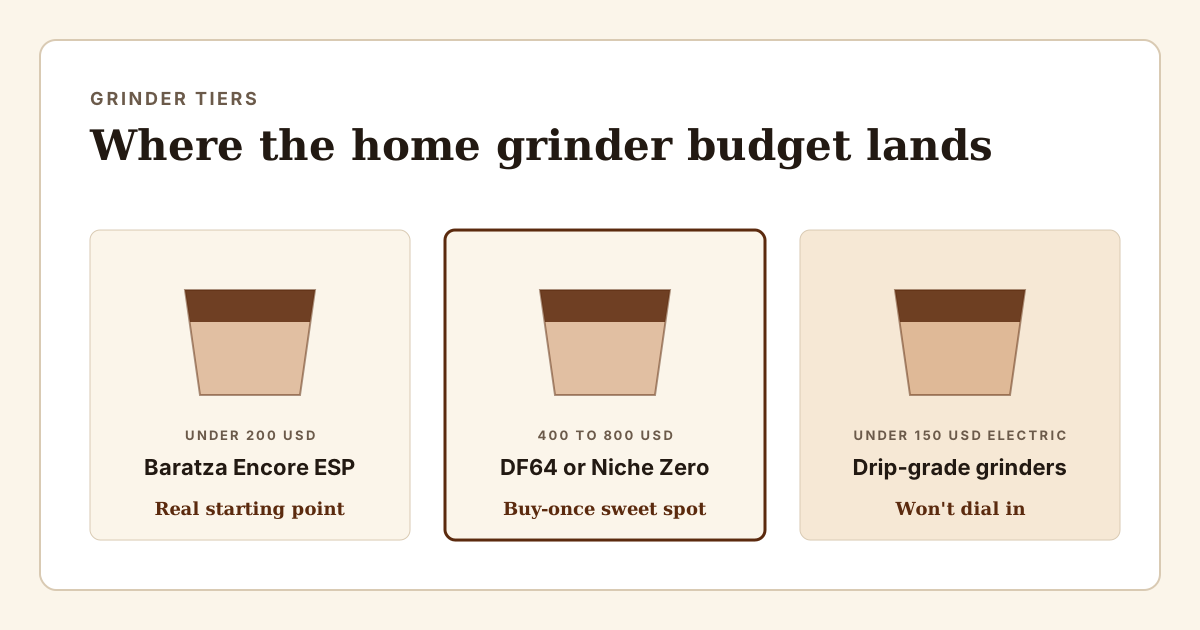
Spend at least 40 percent of your total espresso budget on the grinder, and pick from four shortlist machines that cover almost every home case: Baratza Encore ESP ($170) for tight budgets, DF64 ($400) for value single-dosing, Eureka Mignon Specialita ($600) for hopper convenience, Niche Zero ($800) for the no-compromise home single-doser. Skip everything under $150, skip blade grinders entirely, and don’t buy a grinder that can’t reach espresso fineness no matter how good the reviews are for drip.
If you haven’t picked the machine yet, how to choose your first espresso machine explains why the grinder and machine budgets are linked.
Why the grinder matters more than the machine
The machine controls temperature, pressure, and time. The grinder controls everything else: particle size, particle uniformity, and how the puck resists water. A perfect machine paired with an inconsistent grinder produces channeled, uneven shots that no recipe can rescue. A modest machine paired with a great grinder pulls cafe-quality espresso.
The reason is mechanical. Espresso needs a particle size around 200 to 400 microns, with a tight distribution. Cheap grinders produce a bimodal distribution: a pile of fines and a pile of boulders, with little in between. Water rips through the fines, ignores the boulders, and you get a sour-and-bitter shot at the same time. No tamp pressure, no pre-infusion routine, no machine upgrade fixes this. The burrs do.
This is why every experienced barista on home-espresso forums says the same thing: upgrade the grinder first. It’s also why a Gaggia Classic Pro plus a Niche Zero outperforms a $3,000 dual boiler plus a Baratza Encore. The grinder is the bottleneck.
The four things that actually matter
1. Burr type and size
Conical vs. flat is the debate that gets most of the airtime, but burr size matters as much. Larger burrs (64mm flats, 65mm conicals) grind faster, run cooler, and produce more uniform particles than the 40mm and 50mm burrs in entry-level machines.
- Conical burrs (Niche Zero, Mignon Specialita, most hand grinders): cone-shaped center burr inside a ring. More textured mouthfeel, fuller body, forgiving on medium and darker roasts. Tend to be cheaper to manufacture at a given quality.
- Flat burrs (DF64, Lagom P64, Eureka Atom): two parallel discs. Cleaner separation of flavor notes, brighter in the cup, suit light and modern roasts. Usually need a higher RPM motor and produce more heat.
Below 58mm flat / 38mm conical, you’re in entry territory regardless of brand. Above 64mm flat / 50mm conical, you’re at “I never need to upgrade” territory.
2. Stepless or fine-stepped adjustment
Espresso is sensitive to tiny grind changes. A “step” on a coarse-stepped grinder (most Baratza models, the original Encore) can move shot time by 8 seconds. That’s the difference between sour and bitter, with nowhere to land in between.
What you want:
- Stepless (Niche Zero, Mignon Specialita, DF64): a worm-gear or collar that rotates continuously. You can land anywhere.
- Fine-stepped (Encore ESP, some Eurekas): many small detented steps, fine enough that each one moves shot time 1 to 2 seconds.
- Coarse-stepped: disqualifying for espresso. If the listing says “40 grind settings” and they cover French press to Turkish, espresso lives between two clicks and you can’t get there.
The failure mode: a coarse-stepped grinder where you dial in by tasting “almost right” and accepting it because the next step over is also wrong. You can’t fix this with technique.
3. Retention and the single-dose question
Retention is how much ground coffee stays inside the grinder between dose and dispense. High-retention grinders (most hopper-fed models) hold 5 to 20 grams in the chute and burr chamber. That’s yesterday’s coffee mixed into today’s shot.
Two ways to live with this:
- Use a hopper, leave 100+ grams of beans in it, and accept that the grinder always has stale coffee in the path but it’s the same stale coffee every shot. Works if you drink one bean consistently.
- Single-dose: weigh beans in, grind, repeat. Requires either a low-retention grinder (Niche, DF64, most modern flat-burr single-dosers) or a workflow of bellows and chute-tapping that gets old fast.
Niche Zero retention is around 0.1 g, which is the gold standard. DF64 is 0.5 to 1.0 g with the stock setup, around 0.1 g with aftermarket mods. Older hopper grinders can hold 10 g or more. Single-dosing a high-retention grinder doesn’t work; the old grounds blend into the new ones.
4. Heat and motor quality
Cheap grinders use small, fast motors that heat the burrs after a few back-to-back shots. Heat changes the burr geometry slightly, drifts your dial-in, and roasts oils onto the burr surfaces over time.
You can’t read this off a spec sheet, but you can read it off the wattage and burr size. A 250W motor turning 40mm burrs at 1400 RPM (typical entry electric) gets hot fast. A 150W motor turning 64mm burrs at 400 RPM (Niche, DF64 stock) barely warms up. Direct-drive low-RPM grinders win on heat every time.
For a two-shot-a-day household, this rarely matters. For a busy morning of six drinks, it matters a lot.
Price tiers and what to buy at each
Under $150: hand grinders only
The 1Zpresso J-Max ($160) and Kingrinder K6 ($90) pull espresso that matches grinders three times the price. Electric grinders in this bracket are drip-grade and either won’t go fine enough or have coarse stepping that makes espresso impossible.
If you must have electric under $150, save up another month and buy the Encore ESP. There is no good electric espresso grinder for $100.
$150 to $300: the Baratza Encore ESP
The Encore ESP ($170) is the only mainstream recommendation in this bracket. It’s the standard Baratza Encore re-geared with finer steps and a steeper burr profile to reach espresso fineness. Conical 40mm burrs, fine-stepped (not stepless), high retention by single-dose standards but workable.
It is not as quiet, as fast, or as low-retention as a $400 grinder. It is the best electric espresso grinder you can buy for under $200 and a perfectly reasonable starting point.
$300 to $500: the DF64 family
The DF64 (and its variants: DF64 Gen 2, DF64P, MiiCoffee DF64) is the breakout grinder of the last few years: 64mm flat burrs, stepless, designed for single-dosing, around $400. Specs that used to require an $800 grinder. Build quality is acceptable not exceptional, and you may end up modding it (different burrs, magnetic bellows, declumper) but the platform is strong.
Direct competitors here are the Turin DF64-clones and the older Eureka Mignon Filtro. The DF64 wins on community support, parts availability, and the upgrade path.
$500 to $900: Mignon Specialita or Niche Zero
This is the “buy once” range for most home users.
- Eureka Mignon Specialita ($600): hopper-fed, stepless, conical-ish flat 55mm burrs, very quiet, near-instant grind times. Best choice if you drink one bean for two-plus weeks at a time and want zero workflow friction.
- Niche Zero ($800): single-dose, stepless, 63mm conical burrs, near-zero retention, beautiful object, holds resale value within $50 of new for years. Best choice for bean-switchers and small households.
Pick based on workflow, not specs. Both pull excellent espresso.
$900 and up: flat-burr “endgame”
Lagom P64 ($1,400), Niche Duo ($1,000), Option-O Lagom Mini, DF83, Weber Key. 64mm-plus flat burrs, very low retention, swappable burrs for filter vs. espresso. The cup difference vs. a Niche Zero is real but small. The workflow difference is mostly cosmetic.
Don’t buy here as a first grinder. Buy here when you’ve used a $600 grinder for a year and know exactly which burr profile you want.
Common mistakes
Buying the grinder that came with the machine. Combo machines (Breville Barista Express, Express Impress) include a grinder that’s adequate but not great. Fine as an all-in-one starting point, but the grinder is the part you’ll replace first, not the machine.
Picking conical vs. flat based on forum opinion instead of the beans you drink. If your shelf is medium-roast supermarket espresso, a conical Niche outperforms a flat DF64 in your cup. If your shelf is Sey and Onyx light roasts, the flat wins. The “best burr type” is the one matched to your beans.
Treating low retention as the only spec that matters. A low-retention grinder with sloppy alignment grinds worse coffee than a slightly higher-retention grinder with great burrs. Niche Zero gets retention right and burr quality right; don’t assume every low-retention grinder is in that company.
Buying a hopper grinder, then trying to single-dose it. Most hopper grinders need 50+ g of beans in the throat for the auger to feed correctly. Single-dosing them produces inconsistent doses and popcorning beans. Either commit to a hopper or buy a grinder designed for single-dosing.
Skipping the grinder upgrade because the current shots “taste okay.” They taste okay because you’ve calibrated your tongue to what your grinder produces. Pull one shot on a friend’s Niche or DF64 with the same beans and you’ll hear yourself say “oh.”
Troubleshooting
My shots channel constantly and I have a good machine. Almost always the grinder producing too many fines or too much grind size variation. A WDT tool helps with distribution but doesn’t fix the underlying particle distribution. If you’re on a sub-$200 electric grinder, the grinder is the culprit 80 percent of the time. If you’re not sure the grinder is the cause, work through the espresso troubleshooting decision tree first.
The grinder grinds fine enough on paper but I can’t dial in. Check whether you can land between steps (and see how to dial in espresso for the full process). Coarse-stepped grinders often have one step that pulls in 18 seconds and the next in 35, with no in-between. Buy a stepless or fine-stepped grinder, or live with a recipe that compensates (different dose, different yield).
Should I buy used? Yes for Niche Zero, Mignon Specialita, and most prosumer grinders. Burrs last 500 kg-plus of coffee, which is decades of home use. Watch for: burr damage from rocks (run your finger along the cutting edge), motor brushes worn out on older models, and missing dosing cup or bellows on single-dosers.
My grinder gets hot and the dial-in drifts after three shots. Either the motor is undersized or the burrs are too small for your volume. Workarounds: pause between shots, single-dose to reduce heat buildup. Real fix: bigger burrs and a lower-RPM motor, which usually means a different grinder.
The new grinder tastes worse than the old one. Almost always not broken in. Burrs need 5 to 10 kg of coffee through them before they settle. Some grinders (anything with cast burrs) take longer. Pull a pound of grocery-store beans through it before judging.
Frequently asked
Can I use my drip coffee grinder for espresso?
Almost never. Most drip grinders (Baratza Encore, Capresso Infinity) don't go fine enough or have steps so coarse that you can't dial in. The Encore ESP is the exception: it's the standard Encore re-geared for espresso. Anything labelled 'all-purpose' from the under-$150 range is a drip grinder pretending.
Flat burrs or conical burrs, which is better?
Neither, in absolute terms. Flat burrs (Eureka, DF64, Niche Duo) tend to produce a more uniform grind with clearer separation between flavor notes, which suits light roasts. Conical burrs (Niche Zero, Mignon) tend toward a fuller, more textured body that suits medium and darker roasts. Pick based on the beans you actually drink.
Is the Niche Zero worth the price?
If you can buy one at MSRP and you pull two to four shots a day, yes. Near-zero retention, single-dose workflow, quiet, attractive, holds value used. The downside: it's a conical-burr single-doser, so it's not the best choice if you pull six-plus shots a day or if you want the cleanest light-roast separation. For high-volume households a flat-burr like the Mignon Specialita or Lagom P64 makes more sense.
Do I need a single-doser?
No, but most home setups end up wanting one. Single-dosing (weigh beans in, grind, done) means no stale beans in a hopper and no waste when switching beans. Hopper grinders (Mignon Specialita) make sense if you drink one bean for weeks at a time and pull multiple shots a day. Most enthusiasts switch beans too often for a hopper to be the right call.
What about hand grinders for espresso?
A good hand grinder (1Zpresso J-Max, Kingrinder K6) pulls espresso as well as a $400 electric in the cup. The catch: 60 to 90 seconds of cranking per shot, and it gets old fast above one or two shots a day. Excellent travel option, excellent budget option, terrible daily driver for a household.